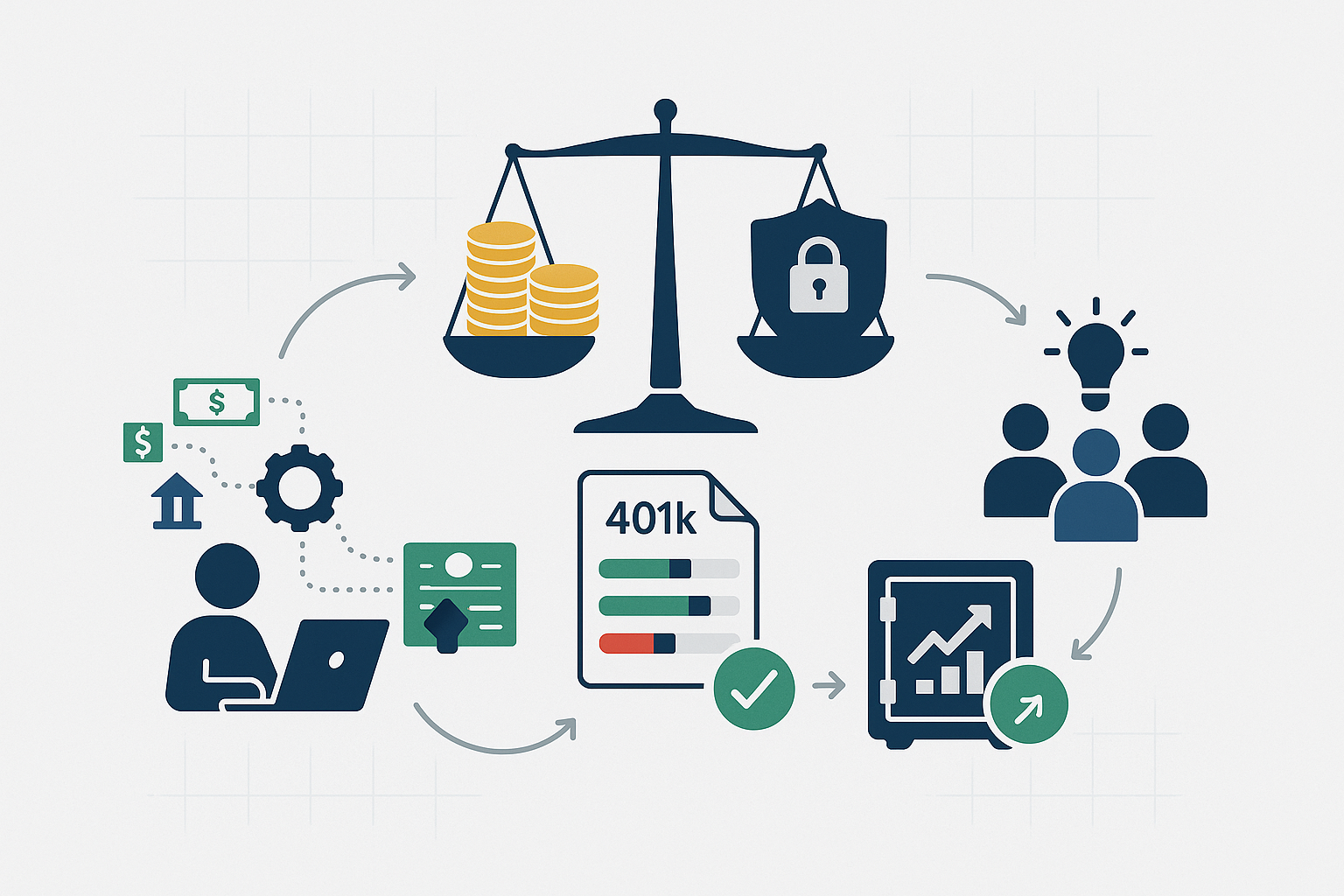







Private equity investments raise a second layer of fiduciary difficulty because they are not simply harder to compare. They are also harder to value, harder to redeem, and harder to explain to participants who may assume daily-priced plan options operate under familiar public-market rules.
Due Diligence

The S&P 500 looks diversified—until you see how few stocks actually drive the returns. As concentration rises, index construction itself is becoming a growing 401k fiduciary risk.

Seasoned advisors caution plan sponsors not to confuse delegation with disappearance. Every fiduciary duty can be shared. None can be erased.
The key is embedding quantitative prompts inside onboarding experiences so participants perceive personalization while fiduciaries collect the data they actually need.

Risk capacity anchors 401k advice in hard data—income stability, net worth, liquidity, and retirement timeline. Unlike tolerance, which shifts with market moods, capacity reflects what participants can afford to lose, aligning with ERISA’s fiduciary duties.
For fiduciaries, the comparison process must go deeper than surface-level performance. Yield is important, but transparency, diversification, and liquidity provisions matter just as much.

Documenting the evaluation process helps protect against potential legal challenges. By proactively managing these red flags, fiduciaries can responsibly integrate private equity into 401k plans and reduce ERISA compliance concerns.

Applying these duties to volatile cryptocurrencies requires careful thought and documentation. How, then, is the industry interpreting this “neutral stance” from the DOL?

Before widespread use, 401k AI personalization needs careful management of fairness, transparency, and fiduciary duty. And when you read “plan sponsors must,” you’re really reading “plan sponsors’ service providers must.”

Here’s where the real disconnect kicks in: participants and pros don’t speak the same language on risk. Participants “feel” it. Meanwhile, advisers whip out rulers like standard deviation or some index, measuring volatility in neat little boxes.